
To access IV Intelligence
Complete IV analysis with HV regimes and vol surface
Choose a plan below to unlock this and Premium+ features
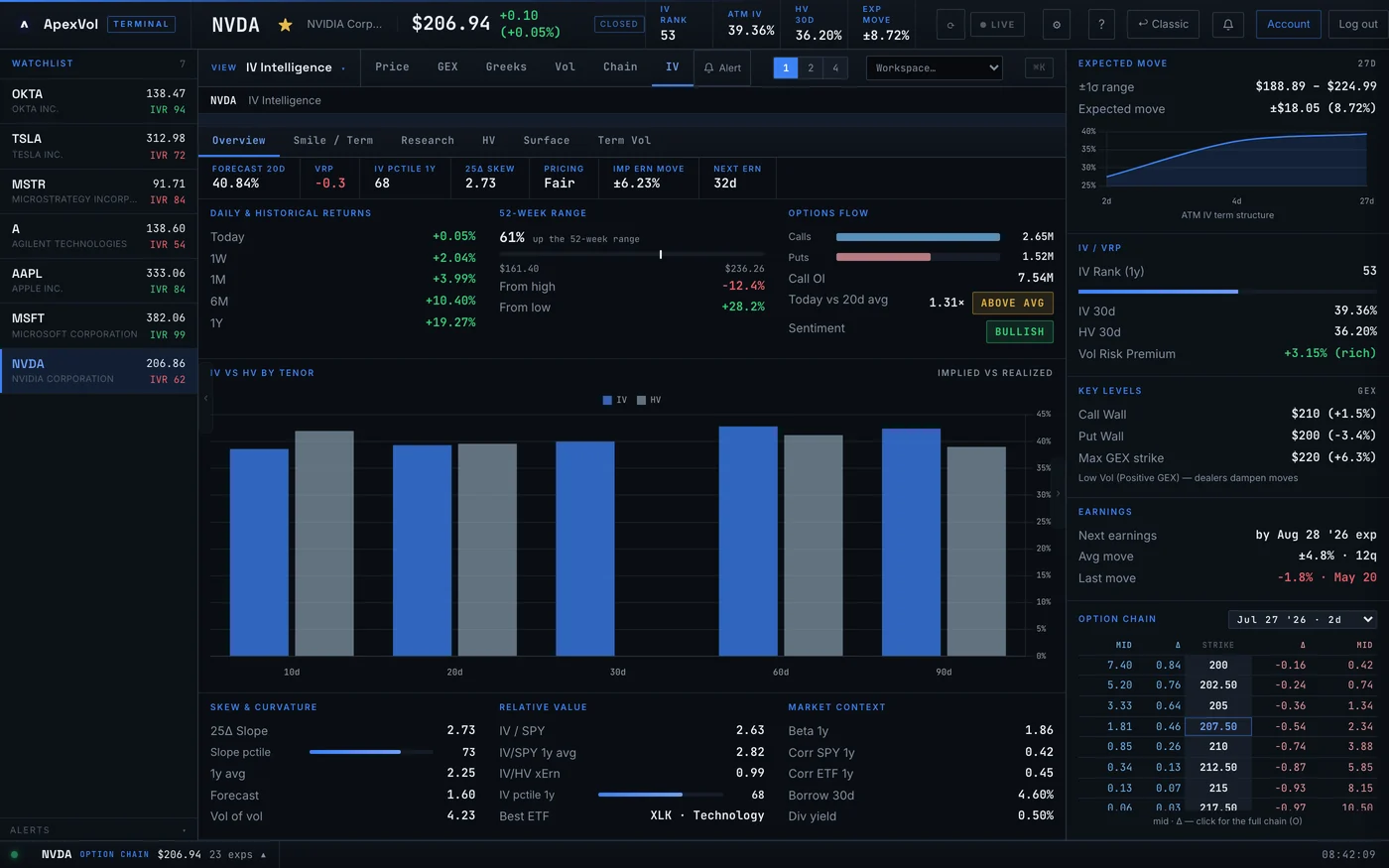
AAPL is free; any other ticker needs the Premium trial, offered inside the Terminal.
One good trade pays for a year.
Live volatility surfaces, dealer GEX, options flow, screener and the strategy lab — across 5,500+ tickers. Pick a tier and start in 60 seconds.
Annual billing (2 months free) is also available — email [email protected] after signing up.
Essential tools for retail traders
Best for: Retail traders getting started with options analytics
- The ApexVol Terminal — one screen, your tier's modules
- Core Analytics
- Dashboard & Live Options Chain
- API & MCP Server — REST API + Claude connector, tier-matched to your plan's data
- Greeks Heatmap (Delta, Gamma, Theta, Vega)
- Strategy Simulator & Payoff Diagrams
- Returns, Flow & Price Summary
- Platform
- 5,500+ Tickers & ETFs
- Real-time Institutional-Grade Data
- 365-Day Historical Data
7 days free·card required·no charge if you cancel
Advanced analytics for serious traders
Best for: Active traders who want volatility and flow analysis
- Everything in Basic, plus:
- Volatility Analytics
- Volatility Lab — 3D surface, IV term structure, smile, vol cone
- Greeks & Positioning
- Greeks Exposure (GEX & flip points, DEX, Vega, Charm, Vanna)
- Flow & Screening
- Options Flow & Sentiment (call/put volume, OI shifts)
- Options Screener (Multi-Factor)
- Market Overview Dashboard
- Stock Analytics
- Dividend Analytics & Calendar
- Correlation & Beta Analysis
- Borrow Rate Monitor
7 days free·card required·no charge if you cancel
Most subscribers choose Premium
Institutional-grade tools for professionals
Best for: Full-time traders and professionals who need every edge
- Everything in Premium, plus:
- Flagship
- Full Terminal unlock — all 50 modules + saved multi-pane workspaces
- Risk & Strategy
- Risk Manager (Portfolio Greeks & Stress Tests)
- Advanced Volatility
- Vol Term Structure Analytics
- IV Shift (Smile Analysis & Vol-Seller Cockpit)
- Mean Reversion & Vol Pairs Scanner
- Volatility Arbitrage Scanner
- Calendar Spreads (Analyzer + IV Ratio)
- Skew Intelligence & Mispricing Signals
- Relative Value Scanner
- Earnings & Events
- Earnings & Events (IV Impact, Straddle Pricing)
- Earnings Straddle Analyzer
- Earnings History & Calendar
- Advanced Greeks & Data
- Higher-Order Greeks (Speed, Zomma, Color)
- Historical Snapshots & Data Export
7 days free·card required·no charge if you cancel
No charge during the trial. Cancel any time before it ends and you pay nothing.
All Plans Include
Compare All Features
| Feature | Free | Basic | Premium | Pro |
|---|---|---|---|---|
| Flagship | ||||
|
ApexVol Terminal
Every analytic in one screen — modules unlock with your tier
|
AAPL | |||
|
Saved Terminal Workspaces
Named multi-pane layouts you can switch in one click
|
||||
| Core Analytics | ||||
|
Scratchpad
Personal notes and freehand annotations that persist between sessions — one global pad plus per-ticker pads
|
||||
|
Volcademy
A taught options volatility course whose questions are answered from the live Terminal
|
AAPL | |||
|
Volcademy: full course
Every Volcademy module after the free first one
|
AAPL | |||
|
API & MCP Server
Claude MCP server plus a documented REST API with self-served Bearer tokens — every plan queries the same data its web tier includes; Pro unlocks the full surface
|
||||
|
Dashboard
Live option chains with Greeks
|
AAPL | |||
| Greeks Analysis | ||||
|
Greeks Heatmap
Visual Greeks across strikes and expirations
|
AAPL | |||
|
Greeks Exposure
Unified Greek exposure analysis — GEX, DEX, Theta, Vega, Charm, Vanna, and higher-order
|
AAPL | |||
| Volatility Tools | ||||
|
Volatility Lab
IV smile, term structure, 3D volatility surface
|
AAPL | |||
|
IV Intelligence
Complete IV analysis with HV regimes and vol surface
|
AAPL | |||
|
Term Vol Analytics
Per-expiration deep dive with strike-level mispricing, probability edge, and institutional positioning
|
AAPL | |||
|
Volatility Arbitrage
Vol arb opportunity scanner
|
||||
|
Calendar Spread Analyzer
IV ratio analysis for calendar and double-calendar spreads
|
AAPL | |||
|
Front/Back IV Ratio
Live IV ratio monitoring for calendar spread entry timing
|
AAPL | |||
|
Calendar Scanner
Market-wide screen for calendar spread candidates by term structure, forward vol and earnings placement
|
AAPL | |||
|
Relative Value Scanner
IV percentile vs SPY & sector, ratio mean-reversion, pairs trade generator
|
||||
|
Skew Intelligence
Skew decomposition, curvature analysis, sector-relative skew, regime bands
|
AAPL | |||
|
IV Shift
Bloomberg-grade IV smile shift analysis with ML forecast overlay, percentile envelopes, demand confluence, and term-structure heatmap
|
AAPL | |||
| Flow Analysis | ||||
|
Options Flow
Call/put volume, open-interest shifts and sentiment per ticker
|
AAPL | |||
|
0DTE Analytics
Real-time zero-days-to-expiration options analysis
|
SPY | |||
| Strategy Tools | ||||
|
Strategy Lab
Build, simulate & analyze multi-leg options strategies
|
AAPL | |||
| Screeners | ||||
|
Options Screener
Bulk IV Rank, VRP, skew & earnings screening
|
||||
| Market Analysis | ||||
|
Market Overview
Market-wide volatility overview with sector heatmap, top movers & earnings calendar
|
||||
| Risk Management | ||||
|
Risk Manager
Portfolio Greeks, scenario analysis, hedging
|
||||
| Event Analysis | ||||
|
Earnings & Events
Earnings IV patterns, historical moves, and straddle pricing analysis
|
AAPL | |||
|
Earnings History
Per-ticker EPS history and beat/miss stats
|
AAPL | |||
|
Earnings Straddle Analyzer
12-quarter move history, straddle pricing accuracy, earnings effect decomposition
|
AAPL | |||
| Stock Analytics | ||||
|
Price Context
Multi-timeframe performance, momentum vs IV scatter, split history
|
AAPL | |||
|
Dividend Analytics
Dividend history, implied vs actual, ex-date behavior, capture opportunities
|
AAPL | |||
|
Correlation Dashboard
Rolling correlation vs SPY & sector ETF, beta regime, decorrelation scanner
|
AAPL | |||
|
Borrow Rate Monitor
Borrow rate time series, hard-to-borrow screener, squeeze candidates
|
AAPL | |||
| Historical Data | ||||
|
Historical Snapshots
Option chain at any historical date/time
|
AAPL | |||