ApexVol Terminal
Options analytics, live.
Chains, IV rank, expected move and dealer positioning for 5,500+ US stocks and ETFs.

Free on AAPL, no account. Trial: no charge if you cancel before it ends.
On this page
Options Chain
is a table displaying all available options for a stock, organized by expiration date and strike price, showing calls on one side and puts on the other.
Also called an option matrix or option board. It's your primary tool for viewing available options and their prices.
Quick answer
An options chain lists calls and puts against a strike ladder for one expiration. Trade off the live bid/ask (not 'last'), use open interest for liquidity, and read implied volatility to judge if an option is expensive. Strike vs stock price sets moneyness (ITM/ATM/OTM).
Open interest — the number of contracts left open at a strike — is the most reliable liquidity signal on an options chain: high open interest is what keeps bid-ask spreads tight enough to enter and exit at a fair price.
An options chain is the menu of every call and put available on a stock, laid out by strike price and expiration. Learning to read it is the first practical skill in options trading — once you can scan a chain, you can find liquid strikes, gauge what the market expects, and price a trade in seconds. This guide walks through every column, the calls-vs-puts layout, and how to spot a tradeable strike.
The Layout: Calls, Puts, and Strikes
Most options chains share a three-part structure:
- Calls on the left, puts on the right (or stacked, on mobile).
- Strike prices down the center — the price at which you can buy (call) or sell (put) the stock.
- One expiration at a time, selected from a date dropdown. Each expiration is its own chain.
The current stock price sits in the middle of the strike ladder. Strikes above it are out-of-the-money (OTM) for calls; strikes below it are OTM for puts.
ApexVol Terminal
Options analytics, live.
Chains, IV rank, expected move and dealer positioning for 5,500+ US stocks and ETFs.

- Live chains and Greeks
- IV rank and percentile
- Expected move and GEX
- Screener and strategy P&L
Free on AAPL, no account. Trial: no charge if you cancel before it ends.
Try this with real market data. 5,500+ stocks, live options chains, IV analytics and P&L. 7-day free trial.
Every Column Explained
| Column | What it tells you |
|---|---|
| Strike | The price you can buy/sell the stock at if exercised. |
| Bid | Highest price a buyer will pay — what you receive if you sell. |
| Ask | Lowest price a seller will accept — what you pay to buy. |
| Last | Price of the most recent trade (can be stale on illiquid strikes). |
| Volume | Contracts traded today — a read on current activity. |
| Open Interest (OI) | Total open contracts — the best gauge of liquidity. |
| Implied Volatility (IV) | The market's forecast of movement priced into that strike. |
| Greeks (Delta, etc.) | Sensitivity to price, time, and volatility (sometimes a separate view). |
The two columns beginners overlook are open interest and implied volatility. OI tells you whether you can get in and out without a wide spread; IV tells you whether the option is expensive or cheap relative to expectations.
The Bid-Ask Spread: Your Hidden Cost
The gap between the bid and ask is the bid-ask spread — effectively a transaction cost. A $0.02 spread on a liquid SPY strike is negligible; a $0.50 spread on a thinly traded strike means you lose money the instant you enter. As a rule, favor strikes with tight spreads, high open interest, and visible volume.
Reading Moneyness: ITM, ATM, OTM
Where a strike sits relative to the stock price defines its character:
- In-the-money (ITM) — has intrinsic value; calls below the stock price, puts above it.
- At-the-money (ATM) — strike nearest the stock price; most time value, most liquid.
- Out-of-the-money (OTM) — pure time value; cheaper, lower probability of finishing in profit.
Many chains shade ITM strikes a different color so you can see moneyness at a glance.
Worked Example
Stock at $100. Looking at the 30-day chain, the $100 call shows: bid $3.10, ask $3.20, volume 1,200, OI 8,500, IV 28%. Reading this: it is at-the-money (all time value), the $0.10 spread is tight, and the 8,500 open interest means it is liquid. The 28% IV is the market's annualized movement forecast — compare it to the stock's IV rank to judge whether that premium is rich or cheap.
You can read a live, fully-loaded chain — with Greeks, IV, and volume for any of 5,500+ tickers — on the options dashboard.
Common Mistakes
- Trading off the "Last" price — it can be hours old. Always quote from the live bid/ask.
- Ignoring open interest — a cheap option you cannot exit is not a bargain.
- Forgetting the expiration — the same strike prices very differently across dates.
Key Takeaways
- Calls and puts are listed against a central ladder of strikes, one expiration at a time.
- Bid/ask are the live tradeable prices; "last" can be stale.
- Open interest is your best liquidity gauge; implied volatility tells you if an option is expensive.
- A strike's position vs the stock price sets its moneyness (ITM/ATM/OTM).
- Favor tight spreads, high OI, and visible volume.
Sources & further reading
- The Options Clearing Corporation (OCC) — exercise, assignment & settlement rules.
- Cboe Options Institute — free options education.
See our research methodology for how ApexVol computes the figures on this page.
Watch
 10:47
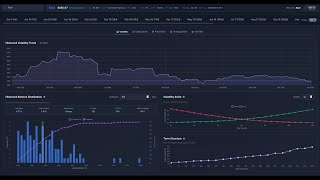
Dashboard Walkthrough: Options Tools ExplainedPart 1 of our 10-part series: a complete walkthrough of the ApexVol dashboard covering options chains, Greeks display, IV analytics, and all core trading tools.
10:47
Dashboard Walkthrough: Options Tools ExplainedPart 1 of our 10-part series: a complete walkthrough of the ApexVol dashboard covering options chains, Greeks display, IV analytics, and all core trading tools.
 1:52
Watchlist: Track Stocks, Contracts and StrategiesA preview of the watchlist two days before launch: tickers, starred contracts with target prices and notes, and a tracked Apple straddle with net Greeks.
1:52
Watchlist: Track Stocks, Contracts and StrategiesA preview of the watchlist two days before launch: tickers, starred contracts with target prices and notes, and a tracked Apple straddle with net Greeks.
Run the numbers before you trade. P&L chart, breakeven & Greeks for any options trade. Free, no signup. Or model any multi-leg trade in the options profit calculator.
Options Profit CalculatorGet this number by API, or in Claude
Historical chain (get_historical_chain in an MCP client), Options chain (get_options_chain in an MCP client): one Bearer token, JSON back, the same tools an assistant calls through the ApexVol MCP server.
curl -H "Authorization: Bearer avmcp_YOUR_TOKEN" \
"https://apexvol.com/api/mcp/data/chain-at-time/SPY?expiration=2026-08-21&trade_date=2026-08-14"Show the SPY chain for 21 August as it was priced on 14 August.
Claude calls get_historical_chainThe endpoint page has every parameter, a real captured response and a console that runs it on your ticker. Tokens come with every paid or trial plan.
- Written by
- ApexVol Research Team
Quantitative options research. All calculations use live institutional-grade data — the same source professional volatility desks use. - Reviewed by
- Ryan Silk, ApexVol Founder
Reviewed for technical accuracy. 10+ years trading options; built ApexVol's pricing engine, Greeks model and IV-rank methodology.
Revised as market conditions and institutional data change. Last revised 2026-06-19. How we research →
Questions
What people ask
about this.
How do you read an options chain?
An options chain lists calls and puts against a central ladder of strike prices for one expiration at a time. Read each row for the bid and ask (the live tradeable prices), volume and open interest (liquidity), and implied volatility (how expensive the option is). The stock's current price sits in the middle of the strikes, defining which contracts are in- or out-of-the-money.
What is open interest on an options chain?
Open interest is the total number of option contracts currently open at a given strike and expiration. It is the best single gauge of liquidity: high open interest usually means tighter bid-ask spreads and easier entry and exit, while low open interest can leave you stuck in a position you cannot exit at a fair price.
What does the bid and ask mean on an options chain?
The bid is the highest price a buyer will pay (what you receive when selling), and the ask is the lowest price a seller will accept (what you pay when buying). The gap between them is the bid-ask spread, an effective transaction cost. Tight spreads indicate a liquid, tradeable strike; wide spreads indicate an illiquid one.
What is implied volatility on an option chain?
Implied volatility (IV) is the market's forecast of how much the stock will move, expressed as an annualized percentage and priced into each option. Higher IV means richer premiums. Comparing a strike's IV to the stock's IV rank tells you whether the option is expensive or cheap relative to its own history.
Should I use the last price or the bid-ask to trade options?
Always use the live bid and ask, not the last price. The 'last' figure shows the most recent trade, which can be hours old on less-active strikes and misleading. Buy near the ask and sell near the bid, and aim to fill between them on liquid contracts.
How do I find liquid options on the chain?
Look for strikes with high open interest, visible daily volume, and a tight bid-ask spread. At-the-money strikes on large, popular underlyings (like SPY, QQQ, or AAPL) are usually the most liquid. Avoid far out-of-the-money or far-dated strikes with little open interest, where spreads widen and fills get expensive.
Keep reading
What this connects to
next.
The free weekly IV report. IV rank movers, volatility notes and options market analysis, weekly.
No account needed. Unsubscribe any time.
Put this into practice
Now price it live.
See these concepts in action with real market data. Every module runs on AAPL without an account, and on 5,500 other tickers with one.
Real market data, not a sandbox. See it live on AAPL.