Understanding How Options Prices Change
Options Greeks Explained: Master Delta, Theta, Vega & Gamma
The complete guide to understanding the options Greeks. Learn how Delta, Theta, Vega, Gamma, and Rho affect your options trades, with real examples and calculators.
ApexVol Terminal
Options analytics, live.
Chains, IV rank, expected move and dealer positioning for 5,500+ US stocks and ETFs.

Free on AAPL, no account. Trial: no charge if you cancel before it ends.
On this page
- The Greeks at a glance
- What the Greeks are
- Delta: directional exposure
- Theta: time decay
- Vega: volatility sensitivity
- Gamma: rate of delta change
- Rho: interest rate sensitivity
- How the Greeks interact
- Greeks summary table
- Greek-by-Greek deep dives
- Sources and further reading
- Frequently asked questions
Options Greeks
Options Greeks are risk measures that describe how an option's price changes in response to different factors like stock price movement (Delta), time decay (Theta), volatility changes (Vega), and more.
Quick answer
Understanding the Greeks is essential for successful options trading as they help predict profit/loss under different market scenarios and manage risk effectively.
The Greeks measure an option's sensitivity to each pricing factor: delta to price, gamma to delta's change, theta to time, vega to volatility, and rho to rates.
Quick Reference: The Greeks at a Glance
- Δ Delta
- Price Sensitivity
- Θ Theta
- Time Decay
- ν Vega
- Volatility Risk
- Γ Gamma
- Delta Change
- ρ Rho
- Interest Rates
Try it: the Greeks for any option
Change an input and watch all five react. It is the fastest way to build the intuition.
Theoretical values from Black-Scholes at a 4.5% risk-free rate, no dividend. For the live chain, open the full Greeks calculator.
Want this on one page?
The options Greeks cheat sheet condenses every Greek's range, quick rule and trade implication into a printable reference.
What Are the Options Greeks?
The options Greeks are risk measures that describe how an option's price changes in response to different factors. They're named after Greek letters (Delta, Theta, Vega, Gamma, Rho) and are calculated using the Black-Scholes model.
Think of the Greeks as the "dashboard" of your options position. Just like a car's dashboard shows speed, fuel, and temperature, the Greeks show you how your option will perform under different market conditions.
Why Greeks Matter
- Predict Profit/Loss: Know exactly how much you'll make or lose in different scenarios
- Manage Risk: Understand your exposure to price, time, and volatility changes
- Select Better Strikes: Choose options with favorable Greek profiles for your strategy
- Time Entries/Exits: Know when to enter and exit based on Greek behavior
Δ Delta
Delta: Directional Exposure
How much your option moves when the stock moves $1
What is Delta?
Delta measures the rate of change in an option's price relative to a $1 change in the underlying stock. It also represents the approximate probability the option will expire in-the-money.
Delta Ranges
- Call options
- Delta ranges from 0 to +1.0
- Put options
- Delta ranges from 0 to -1.0
- Stock
- Delta is always +1.0 (moves $1 for $1)
Real Example
Scenario: AAPL is at $180. You buy a $185 call for $5 with 0.45 Delta.
If AAPL rises to $181: Your option gains approximately $0.45 in value (now worth $5.45)
If AAPL falls to $179: Your option loses approximately $0.45 (now worth $4.55)
Profit calculation: Own 10 contracts? Stock up $1 = gain $450 (10 contracts x 100 shares x $0.45)
Delta as Probability
Delta also approximates the probability an option will expire in-the-money (ITM):
- 0.30 Delta
- ~30% chance of expiring ITM
- 0.50 Delta
- ~50% chance, ATM options
- 0.80 Delta
- ~80% chance, deep ITM
Important Delta Concepts
- Delta is NOT constant: It changes as the stock moves (that's Gamma's job to measure)
- ATM options: Have ~0.50 Delta (50% probability, move half as much as stock)
- Deep ITM options: Have Delta near 1.0 (move almost dollar-for-dollar with stock)
- OTM options: Have low Delta (move very little compared to stock)
Θ Theta
Theta: Time Decay
How much value your option loses every day
What is Theta?
Theta measures time decay - the amount an option's value decreases as one day passes, assuming all other factors remain constant. Theta is the enemy of option buyers and the friend of option sellers.
Critical Fact About Theta
Theta accelerates as expiration approaches. An option with 90 days to expiration might lose $5/day, but the same option with 10 days left might lose $20/day. The last 30 days is when Theta decay goes exponential.
Real Example
Scenario: You buy a TSLA $250 call for $10 with Theta of -0.15
Tomorrow (if stock doesn't move): Your option is worth $9.85 (-$0.15 per share)
In 10 days: You've lost ~$1.50 per share just to time decay ($150 per contract)
This is why holding options is expensive: Every day costs you money even if you're right about direction.
Theta Decay Curve
Theta is NOT linear - it accelerates dramatically near expiration:
| Time to Expiration | Decay Pace | Rate | Cost per Day |
|---|---|---|---|
| 90 DTE | Slow decay | -$0.05/day | |
| 45 DTE | Moderate decay | -$0.12/day | |
| 30 DTE | Fast decay | -$0.20/day | |
| 7 DTE | Extreme decay | -$0.40/day |
How to Use Theta to Your Advantage
If You're BUYING Options:
Theta is the cost of being early
- Buy options 60-90 days out minimum
- Avoid buying with <30 DTE (Theta too high)
- Need the stock to move FAST to overcome Theta
- Theta decay accelerates in the final 30 days
If You're SELLING Options:
Theta is the income
- Sell options 30-45 DTE for max Theta
- Theta is your profit, collect it daily
- Target closing at 50% profit (Theta slows)
- Avoid selling long-dated (Theta too slow)
ν Vega
Vega: Volatility Sensitivity
How IV changes affect your option's value
What is Vega?
Vega measures how much an option's price changes when implied volatility (IV) changes by 1%. Higher IV = higher option prices. Lower IV = lower option prices. Vega affects ALL options - calls and puts.
Real Example
Scenario: SPY $450 put trading at $8 with Vega of 0.25. Current IV is 20%.
If IV rises to 21%: Your option gains $0.25 in value (now worth $8.25)
If IV rises to 30% (like before earnings): Your option gains $2.50 (now worth $10.50)
This is why options get expensive before earnings: IV spikes, Vega amplifies prices.
IV Crush Warning
After earnings, IV typically crashes 30-50%. Even if the stock moves in your favor, you can still lose money due to Vega working against you. This is called "IV crush" and destroys countless option buyers every earnings season.
How to Trade Vega
Buy When IV is Low
Long Vega
- Check IV percentile (want <30th percentile)
- Buy before volatility events (earnings, Fed)
- Benefit as IV expands (Vega gains)
- Sell before the event (capture IV expansion)
Sell When IV is High
Short Vega
- Check IV percentile (want >70th percentile)
- Sell right before earnings (IV peak)
- Benefit as IV contracts (Vega profit)
- Iron condors/credit spreads excel here
Γ Gamma
Gamma: Rate of Delta Change
How fast your Delta changes
What is Gamma?
Gamma measures how much Delta changes when the stock moves $1. It's the "acceleration" of your position. High Gamma = Delta changes rapidly. Low Gamma = Delta changes slowly.
Real Example
Scenario: You own a call with 0.50 Delta and 0.05 Gamma
Stock rises $1: Your Delta increases from 0.50 to 0.55 (thanks to Gamma)
Stock rises another $1: Your Delta is now ~0.60
Why this matters: Your gains accelerate as the stock moves in your favor. First $1 = $50 profit, second $1 = $55 profit, third $1 = $60 profit (per contract).
Gamma Characteristics
- ATM options have highest Gamma
- Delta changes fastest near the strike price
- Gamma increases near expiration
- Short-dated options have explosive Gamma
- Long Gamma = Good for buyers
- Your Delta increases when stock moves your way
- Short Gamma = Risk for sellers
- Your Delta works against you on big moves
ρ Rho
Rho: Interest Rate Sensitivity
How interest rates affect options (usually negligible)
What is Rho?
Rho measures how much an option's price changes when interest rates change by 1%. In practice, Rho is the least important Greek for most traders because interest rate changes are rare and gradual.
When Rho matters: Long-dated LEAPS options (1-2 years out) or during periods of rapid Fed rate changes. For short-term options (<90 days), you can usually ignore Rho completely.
How the Greeks Interact
The Greeks don't exist in isolation - they interact with each other in complex ways:
Gamma affects Delta
As the stock moves, Gamma causes Delta to change. High Gamma = fast Delta changes = more volatility in your P&L.
Vega decreases as expiration nears
Short-dated options have less Vega because there's less time for volatility to matter. Long-dated options have high Vega.
Theta accelerates with high Gamma
ATM options near expiration have both high Gamma and high Theta - explosive price action in both directions.
Delta and Vega work together
Stock moves up = Delta profit. IV rises = Vega profit. If both happen (volatility event), gains multiply.
See Greeks on real options. Our free options profit calculator shows all five Greeks for any position, single-leg or multi-leg. Live institutional data, no signup.
Open the Greeks calculatorQuick Reference: Greeks Summary
| Greek | Measures | Range | Good For |
|---|---|---|---|
| Delta (Δ) | Price sensitivity | 0 to +/-1.0 | Directional exposure |
| Theta (Θ) | Time decay | Always negative | Option sellers |
| Vega (ν) | IV sensitivity | Always positive | Volatility plays |
| Gamma (Γ) | Delta change rate | Always positive | Option buyers |
| Rho (ρ) | Rate sensitivity | Small values | LEAPS traders |
Greek-by-Greek Deep Dives
Sources & further reading
- Cboe Options Institute, free education on the Greeks and options pricing.
- SEC Investor.gov, the regulator's plain-language options guide.
See our research methodology for the exact Black-Scholes formulas behind each Greek.
Watch
 10:47
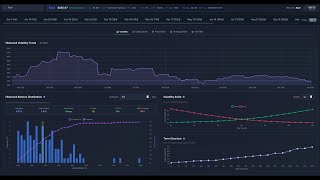
Dashboard Walkthrough: Options Tools ExplainedPart 1 of our 10-part series: a complete walkthrough of the ApexVol dashboard covering options chains, Greeks display, IV analytics, and all core trading tools.
 1:02
What Is Delta? Options Delta Explained with NVDADelta is the change in an option's price for a $1 move in the stock. A one minute lesson with a real Nvidia call, and why the number cuts both ways.
Taught in Volcademy
A free course in order, with questions you answer on the live market. See every module
Run the numbers before you trade. Delta, gamma, theta, vega & rho for any option. Free, no signup. Or model any multi-leg trade in the options profit calculator.
Greeks CalculatorApexVol Terminal
Options analytics, live.
Chains, IV rank, expected move and dealer positioning for 5,500+ US stocks and ETFs.

- Live chains and Greeks
- IV rank and percentile
- Expected move and GEX
- Screener and strategy P&L
Free on AAPL, no account. Trial: no charge if you cancel before it ends.
Try this with real market data. 5,500+ stocks, live options chains, IV analytics and P&L. 7-day free trial.
- Written by
- ApexVol Research Team
Quantitative options research. All calculations use live institutional-grade data — the same source professional volatility desks use. - Reviewed by
- Ryan Silk, ApexVol Founder
Reviewed for technical accuracy. 10+ years trading options; built ApexVol's pricing engine, Greeks model and IV-rank methodology.
Revised as market conditions and institutional data change. Last revised 2026-07-12. How we research →
Questions
Frequently asked
about the Greeks.
What are the options Greeks?
The options Greeks are mathematical measurements that describe how an option's price changes in response to different factors. The main Greeks are Delta (price movement sensitivity), Theta (time decay), Vega (volatility sensitivity), Gamma (Delta change rate), and Rho (interest rate sensitivity). Understanding Greeks is essential for successful options trading since they help predict profit/loss under different scenarios.
What is Delta in options?
Delta measures how much an option's price changes when the underlying stock moves $1. Call options have positive Delta (0 to 1.0), put options have negative Delta (0 to -1.0). A call with 0.50 Delta gains about $0.50 when the stock rises $1. Delta also approximates the probability the option will expire in-the-money.
What is Theta in options?
Theta measures time decay — how much value an option loses each day as expiration approaches. Theta is always negative for option buyers and positive for option sellers. A Theta of -0.10 means the option loses about $10/day in value, and decay accelerates in the final 30 days before expiration.
What is Vega in options?
Vega measures how much an option's price changes when implied volatility (IV) moves by 1%. Higher IV means higher option prices — a Vega of 0.20 adds about $20 per contract for each 1-point rise in IV. Buy options when IV is low and sell when IV is high to put Vega on your side.
What is Gamma in options?
Gamma measures how fast Delta changes as the stock price moves. A Gamma of 0.05 means Delta increases by 0.05 for every $1 move in the underlying. Gamma peaks for at-the-money options near expiration — that's what makes 0DTE trading so explosive. Buyers are long gamma (big payoffs on sharp moves); sellers are short gamma (steady profit, sharp losses on gap moves).
Which Greek is most important?
For option buyers, Theta (time decay) is most critical because it works against you every day. For option sellers, Delta (directional risk) is most important to manage. Successful traders monitor all of them together, since the right priority depends on your strategy and market conditions.
How do Delta, Gamma, Theta, and Vega work together?
Buying an option gives you positive Delta/Gamma/Vega and negative Theta — you pay time decay for convexity and volatility exposure. Selling an option flips all four signs. Strategies like iron condors are built to be Delta-neutral (no directional bet) while collecting Theta and staying short Vega.
Where can I get options Greeks data for free?
ApexVol's free Greeks calculator computes Delta, Gamma, Theta, Vega, and Rho for any option or multi-leg strategy using live institutional market data — no signup required for AAPL. Most retail brokers show Delta and Theta on the chain but bury or omit Gamma, Vega, and Rho, and none show second-order Greeks like Charm or Vanna.
Keep reading
What this connects to
next.
The free weekly IV report. IV rank movers, volatility notes and options market analysis, weekly.
No account needed. Unsubscribe any time.
Read the Greeks off a live chain
Now price it live.
Delta, gamma, theta, vega and rho on every strike, priced against the market rather than a worked example. Every module runs on AAPL without an account, and on 5,500 other tickers with one.
Real market data, not a sandbox. See it live on AAPL.